


IT equipment disposal is no longer something businesses can treat as an afterthought or a simple cleanup task at the end of a device’s life. Every computer, server, laptop, and storage device holds layers of sensitive information that can still be recovered long after it is no longer in use. Along with this hidden data risk, there is also a growing environmental responsibility attached to outdated electronics. IT equipment disposal is the structured process of retiring old technology in a controlled and secure way that protects data, recovers remaining value from hardware, and reduces the environmental harm caused by electronic waste.
In today’s digital world, IT equipment disposal has become a critical part of e-waste management rather than a secondary activity. Businesses now rely heavily on technology, which means the volume of outdated or replaced devices is increasing rapidly. Whether you are a small business replacing office computers, a large organization upgrading entire server systems, or an individual switching personal devices, understanding IT equipment disposal is essential. It ensures you do not unintentionally leave behind security vulnerabilities, compliance issues, or harmful e-waste that can impact the environment.
This guide walks through everything in a simple, practical, and structured way so you can clearly understand how IT equipment disposal works in real situations, why it matters for both security and sustainability, and how you can carry out the process correctly without risking data or wasting valuable resources.
Table of Contents
IT equipment disposal and why it matters in today’s digital world
IT equipment disposal has evolved from simple “throwing away old computers” into a highly structured and regulated process. The reason is simple: modern devices store massive amounts of sensitive information.
Even when files are deleted, data often remains recoverable. This is why IT equipment disposal is essential for protecting personal, financial, and corporate information. A single improperly disposed device can expose entire systems to data breaches.
Beyond security,IT asset lifecycle management also plays a major environmental role. Electronics contain hazardous materials that can damage soil and water if dumped improperly. Proper IT equipment disposal ensures these materials are handled safely and recycled responsibly.
Key importance of IT equipment disposal:
- Prevents data leaks and identity theft
- Reduces environmental pollution from e-waste
- Ensures legal and regulatory compliance
- Supports sustainable business practices
- Improves corporate responsibility reputation
IT equipment disposal is no longer optional. It is a necessary part of modern digital hygiene.
IT equipment disposal process explained step by step
Understanding how IT equipment disposal works helps you avoid costly mistakes and ensures every device is handled safely, securely, and efficiently. The process is not random or informal; it follows a structured workflow designed to protect data, maximize value recovery, and reduce environmental impact.
Step 1 – Inventory and assessment
The first stage of IT equipment disposal begins with identifying all outdated, unused, or end-of-life devices within an organization. This usually includes laptops, desktop computers, servers, storage drives, printers, and networking equipment.
At this stage, a complete inventory is created so nothing is missed or left unmanaged. Each item is then carefully evaluated based on its age, performance condition, and potential for reuse or resale. Some devices may still have significant operational value, while others may be too outdated or damaged to recover.
Proper assessment is important because it helps organizations decide the most efficient path for each asset. It also prevents unnecessary waste and ensures IT equipment disposal is both cost-effective and environmentally responsible.
Step 2 – Secure data removal
This is the most critical and sensitive stage of IT equipment disposal because it directly involves data security and privacy protection.
Simply deleting files or formatting a drive is not enough, because data can still be recovered using specialized recovery tools. For this reason, professional IT asset lifecycle management relies on advanced data destruction techniques that ensure complete and irreversible removal of information.
Common secure methods include:
- Secure data wiping software that overwrites data multiple times
- Multi-layer overwriting techniques that eliminate recoverable traces
- Physical destruction of hard drives and storage media for high-security cases
In some cases, a more advanced technique called degaussing is used. This process applies a powerful magnetic field to disrupt and erase data stored on magnetic media such as hard drives and tapes. Once degaussing is performed, the data becomes completely unreadable and cannot be restored by any recovery method.
This stage ensures that sensitive business or personal information does not fall into the wrong hands after IT equipment disposal.
Step 3 – Sorting and segregation
After data has been securely removed, IT equipment disposal moves into the sorting and segregation phase. This step determines what happens to each device next based on its condition and usability.
Devices are typically divided into three categories:
- Fully functional equipment that can be refurbished and reused
- Partially functional devices that can be repaired, upgraded, or resold
- End-of-life devices that are no longer usable and must be dismantled for recycling
This structured sorting process ensures that e-waste management minimizes waste and maximizes resource recovery. It also supports sustainability efforts by extending the lifecycle of usable devices and ensuring non-usable components are properly recycled instead of being sent to landfill.
IT equipment disposal benefits for businesses and individuals
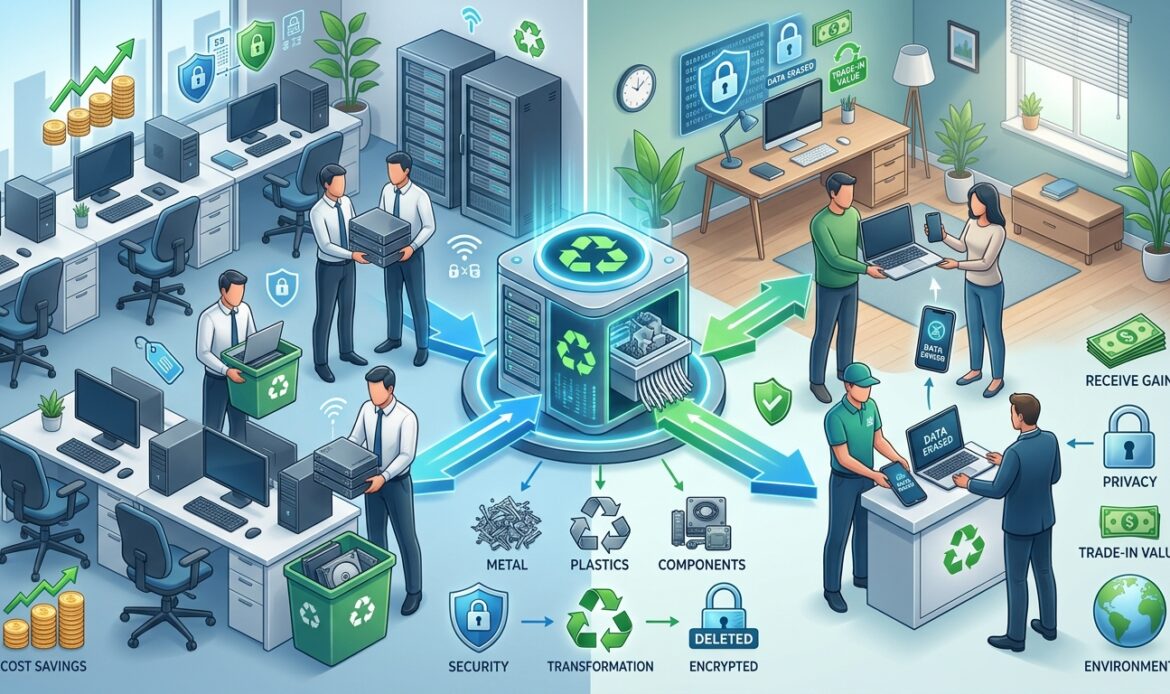
IT equipment disposal is not just about getting rid of old machines or clearing up unused hardware. It delivers a combination of financial, security, and environmental benefits that apply not only to organizations but also to individuals who regularly upgrade their devices or replace outdated technology.
For individuals, IT equipment disposal is especially important because personal laptops, phones, and storage devices often contain sensitive data such as passwords, photos, financial details, and personal documents. Proper disposal ensures that this information does not remain accessible after the device is no longer in use.
Financial benefits
Proper IT equipment disposal can help individuals and businesses recover value from old devices instead of letting them go to waste. Many laptops, desktops, and other electronic devices still have resale or refurbishment value even after daily use.
Individuals can sell or trade in old devices, reducing the cost of upgrading to new technology. In some cases, refurbished equipment can also be reused for secondary purposes such as backup systems or learning setups. This makes IT equipment disposal a practical way to save money while upgrading technology responsibly.
Security benefits
IT equipment disposal plays a major role in protecting sensitive personal and business information. Even after deleting files, data can often remain stored on devices and may be recovered if not properly erased.
For individuals, this includes risks such as exposure of personal photos, login credentials, banking information, and private documents. Proper data secure IT disposal ensures complete data removal and protects against:
- Corporate or personal data leaks
- Identity theft and fraud
- Unauthorized access to personal accounts
- Cybersecurity breaches targeting stored information
This makes secure IT equipment disposal essential for protecting digital privacy in everyday life.
Environmental benefits
Electronic waste is one of the fastest-growing waste streams globally, and individuals contribute to it through frequent device upgrades. IT equipment disposal ensures that old electronics are handled responsibly instead of being dumped in landfills.
Proper disposal allows valuable materials like metals, plastics, and circuit components to be recovered and reused. It also reduces pollution caused by harmful substances such as lead, mercury, and other toxic elements found in electronic devices.
For individuals, IT equipment disposal is a simple but powerful way to reduce environmental impact and contribute to a more sustainable digital ecosystem.
For businesses looking to streamline the full lifecycle of their IT assets, professional IT asset deployment services ensure smooth setup, configuration, and integration of new systems into existing infrastructure. IT Asset Deployment Services
IT equipment disposal methods used in modern industry
There are several methods used in secure IT disposal depending on the security requirements, industry standards, and the condition of the devices being handled. In professional environments, especially within large organizations and regulated sectors, these methods are carefully selected to ensure both data protection and environmental responsibility.
For industries like finance, healthcare, government, and enterprise IT services, IT equipment disposal is not a casual process. It follows strict protocols because the risk of data exposure is extremely high. Each method is chosen based on how sensitive the stored information is and whether the device can be reused or must be permanently destroyed.
Physical destruction
Physical destruction is considered the most secure method of IT equipment disposal, especially in industries where data sensitivity is extremely high. In this process, devices are physically broken down so that no part of the storage medium remains usable.
Hard drives, SSDs, and other storage components are typically shredded, crushed, or pulverized into small fragments. Once this process is complete, data recovery becomes impossible, even with advanced forensic tools.
This method is commonly used for:
- Hard drives
- Storage devices
- High-security corporate or government equipment
Physical destruction is often the final step when data must be guaranteed unrecoverable during IT equipment disposal.
Data wiping
Data wiping is a software-based IT equipment disposal method widely used in industries where devices are intended for reuse, resale, or redeployment. Instead of physically destroying hardware, specialized software is used to overwrite existing data multiple times with random patterns.
This process ensures that original information cannot be reconstructed or recovered through standard or advanced recovery techniques. It is a cost-effective and environmentally friendly approach because it extends the life of devices.
Data wiping is suitable for:
- Reusable laptops and desktops
- Enterprise systems being redeployed
- Devices prepared for resale or donation
It is a key balance between security and sustainability in IT equipment disposal practices.
Recycling
Recycling is an essential part of IT asset lifecycle management that focuses on recovering valuable raw materials from outdated electronic devices. Once equipment is dismantled, components such as circuit boards, metals, and plastics are carefully separated and processed.
Materials like copper, gold, aluminum, and other reusable elements are extracted and reintroduced into manufacturing cycles. This reduces the need for raw material mining and helps lower environmental impact.
Recycling in IT equipment disposal supports sustainability goals by reducing electronic waste and promoting a circular economy where resources are reused instead of discarded.
Electronics waste management challenges and risks
While electronics waste management is essential for data protection and environmental responsibility, it is not a simple or risk-free process. Organizations and individuals often face several challenges that can lead to serious consequences if the disposal process is not managed properly. These risks make it important to follow structured procedures and use secure disposal methods.
Poor planning or informal disposal practices can turn old devices into sources of data leaks, environmental harm, or operational confusion. Understanding these challenges helps in building safer and more reliable IT equipment disposal systems.
Data security risks
One of the most critical challenges in IT equipment disposal is data security. Many people assume that deleting files or resetting a device is enough, but in reality, data often remains stored on the hardware and can be recovered using advanced recovery tools.
If IT equipment disposal is not handled properly, sensitive information such as business records, customer data, login credentials, or personal files can be exposed. This can lead to serious problems including financial loss, reputational damage, and privacy violations.
For businesses, the risk is even higher because a single improperly disposed device can compromise an entire network of confidential information. This is why secure data destruction is a non-negotiable part of IT equipment disposal.
Environmental risks
Improper electronics waste management can also create significant environmental hazards. Electronic devices contain harmful substances such as lead, mercury, cadmium, and other toxic materials that should never be released into the environment.
When these devices are dumped in landfills or handled incorrectly, these toxic components can leak into soil and water systems, causing long-term ecological damage. This not only affects ecosystems but can also impact human health in surrounding areas.
Proper IT equipment disposal ensures that these materials are safely extracted, treated, and recycled instead of being left to pollute the environment.
Operational challenges
Large organizations often face operational difficulties when managing IT asset lifecycle management at scale. Companies may have thousands of devices spread across multiple departments, locations, and systems, making tracking and coordination complex.
Without proper asset management systems, it becomes difficult to identify which devices are ready for disposal, which can be reused, and which require secure destruction. Compliance requirements also add another layer of complexity, as organizations must ensure all disposal activities meet legal and regulatory standards.
Logistics, storage, transportation, and coordination with certified disposal vendors further increase the complexity of IT equipment disposal, making structured planning essential for smooth execution. For organizations looking to manage their assets more efficiently, professional support through IT asset audit and management services can help streamline tracking, compliance, and secure IT equipment disposal processes. IT Asset Audit & Management Services
IT equipment disposal best practices
To ensure safe, secure, and efficient IT equipment disposal, organizations and individuals need to follow structured best practices rather than relying on informal or ad-hoc methods. Proper planning not only reduces risk but also improves cost recovery and environmental outcomes. When IT equipment disposal is handled correctly, it becomes a controlled process instead of a potential liability.
Maintain asset tracking
One of the most important best practices in IT equipment disposal is maintaining complete asset tracking throughout the entire lifecycle of every device. This means recording each item from the moment it is purchased, used, upgraded, and eventually retired.
Proper tracking helps organizations know exactly where each device is and what condition it is in before disposal begins. It also prevents devices from being lost, misplaced, or disposed of without proper authorization. With accurate records, IT equipment disposal becomes more organized, transparent, and accountable.
Use certified disposal services
Using certified professionals is another essential step in IT equipment disposal. Certified disposal providers follow strict legal, environmental, and security standards to ensure that data is fully destroyed and materials are handled responsibly.
These services often provide documentation or certificates confirming that data has been securely erased or destroyed. This is especially important for businesses that must comply with data protection laws and industry regulations.
By relying on certified IT equipment disposal services, organizations reduce risk and ensure that both security and environmental responsibilities are properly fulfilled.
Follow structured recycling systems
A structured recycling system is crucial for efficient data secure IT disposal. Instead of treating all devices the same way, equipment should be carefully categorized based on condition and usability.
Devices that still function can be refurbished or reused, while partially working equipment can be repaired or repurposed. Items that are completely unusable should be sent for material recovery and recycling.
This structured approach ensures that electronics waste management minimizes waste, maximizes resource recovery, and supports environmentally responsible practices.
IT equipment disposal regulations and compliance
IT equipment disposal is heavily regulated in many countries because it directly involves two sensitive areas: data security and environmental protection. Governments and regulatory bodies have introduced strict rules to ensure that organizations handle electronic waste responsibly and do not expose sensitive information during disposal.
For businesses, compliance is not optional. It is a legal requirement that ensures customer data, financial records, and internal systems are properly protected even after devices reach end-of-life. IT equipment disposal must therefore follow established standards that align with both privacy laws and environmental regulations.
Organizations are typically required to follow:
- Data protection laws that ensure sensitive information is securely destroyed
- Environmental waste regulations that control how electronic waste is processed and recycled
- Industry compliance standards that define safe and auditable disposal practices
Failure to comply with proper IT equipment disposal procedures can lead to serious consequences such as financial penalties, legal action, and reputational damage. In some industries, non-compliance can even result in loss of certifications or operating licenses, making compliance a critical part of IT equipment disposal strategy.
IT equipment disposal lifecycle approach
IT equipment disposal is not an isolated activity that happens at the end of a device’s life. Instead, it is part of a complete IT asset lifecycle that begins from the moment a device is purchased and continues until it is fully retired and disposed of.
Understanding this lifecycle helps organizations manage technology more efficiently and reduce unnecessary costs. It also ensures that IT equipment disposal is planned in advance rather than treated as an urgent or unstructured task.
The typical IT asset lifecycle includes:
- Procurement, where devices are selected and purchased based on organizational needs
- Usage, where equipment is actively used for daily operations and business tasks
- Maintenance, where systems are updated, repaired, and optimized for performance
- End-of-life disposal, where devices are securely retired through structured responsible e-waste management processes
When organizations manage the full lifecycle effectively, IT equipment disposal becomes more predictable, controlled, and cost-efficient. It also reduces waste, improves resource utilization, and ensures that devices are disposed of in a secure and environmentally responsible way.
IT equipment disposal in modern enterprises
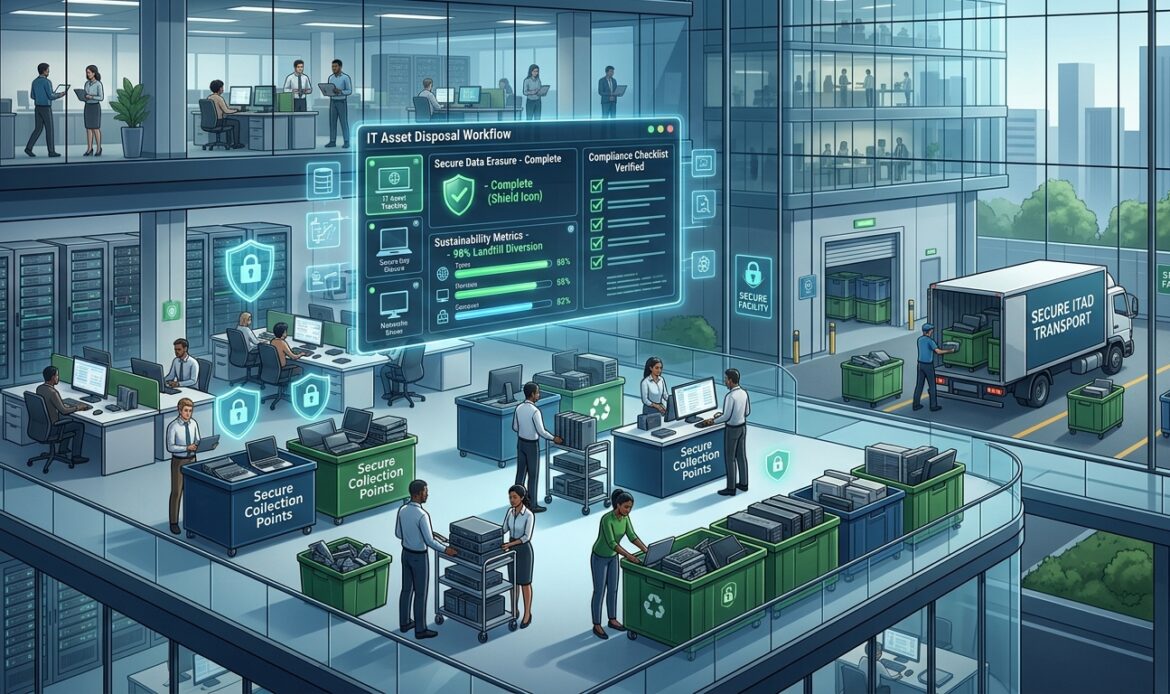
In modern enterprises, IT equipment disposal is far more complex than simply discarding old devices. Large organizations manage thousands of laptops, desktops, servers, and networking systems across multiple departments and locations. Because of this scale, IT equipment disposal requires a structured, centralized, and highly controlled approach to avoid security gaps and operational chaos.
Without a proper system in place, outdated devices can easily be overlooked, mismanaged, or even lost, creating both data security risks and financial inefficiencies. That is why enterprises treat IT equipment disposal as a formal business process rather than a one-time activity.
A proper enterprise approach to responsible e-waste management usually includes several key components:
- Scheduled asset audits that regularly identify devices reaching end-of-life and ensure nothing is left unmanaged
- Centralized disposal systems that create a single controlled process for handling all retired IT assets across the organization
- Secure transport of devices to ensure hardware is safely moved without risk of tampering or data exposure during transit
- Vendor compliance checks to verify that third-party disposal partners follow strict security, legal, and environmental standards
When these systems work together, data secure IT disposal becomes more efficient, traceable, and secure, allowing enterprises to reduce risk while improving overall asset management performance.
IT equipment disposal industry and IT asset disposition
IT equipment disposal is widely managed under a specialized sector known as the IT asset disposition (ITAD) industry. This industry focuses on the secure, efficient, and responsible retirement of IT assets while ensuring that data is fully protected and maximum value is recovered from outdated equipment.
In practice, IT equipment disposal within the ITAD industry is not just about destruction or recycling. It also includes refurbishment, resale, data sanitization, and detailed reporting for compliance purposes. This makes it a complete lifecycle solution for managing retired technology in both small businesses and large enterprises.
The ITAD industry plays a crucial role in bridging security needs with environmental responsibility, ensuring that IT equipment disposal supports both data protection standards and sustainable recycling practices.
IT equipment disposal technologies
Modern IT equipment disposal has evolved significantly with the help of advanced technologies that improve security, efficiency, and transparency. Instead of manual or basic methods, organizations now rely on automated and intelligent systems to manage large volumes of electronic waste.
Some of the key technologies used in IT equipment disposal include:
- Automated shredding machines that physically destroy storage devices with high precision to ensure complete data elimination
- AI-based asset tracking systems that monitor equipment throughout its lifecycle and reduce the risk of loss or mismanagement
- Secure cloud reporting platforms that provide detailed records of disposal activities for auditing and compliance purposes
- Advanced data sanitization software that permanently erases digital information using certified wiping and overwriting techniques
These technologies make IT equipment disposal faster, safer, and more reliable while also improving accountability and environmental compliance across the entire process.
Future of IT equipment disposal
The future of e-waste management is rapidly evolving as technology, regulations, and environmental awareness continue to advance. Organizations are no longer focusing only on getting rid of old devices; instead, they are building smarter, more sustainable systems that integrate automation, security, and circular economy principles.
One major shift is automation. Future IT equipment disposal processes will rely heavily on AI-driven systems that can automatically track devices, classify their condition, and recommend the best disposal method. This reduces human error and makes large-scale disposal faster and more accurate.
Sustainability is also becoming a central focus. Companies are moving toward zero-waste models where as much hardware as possible is reused, refurbished, or recycled instead of being discarded. This approach reduces environmental impact and supports global efforts to minimize electronic waste.
At the same time, data protection standards are becoming stricter. Future IT equipment disposal systems will likely include stronger encryption-based destruction methods, real-time audit trails, and fully transparent reporting to ensure complete accountability throughout the disposal process.
Overall, the future points toward a smarter, greener, and more secure IT equipment disposal ecosystem where technology itself helps solve the challenges created by technology.
Conclusion
IT equipment disposal is an essential process in the modern digital world that connects three critical priorities: data security, environmental responsibility, and efficient resource management. As organizations and individuals continue to generate increasing amounts of electronic waste, the importance of handling outdated devices in a structured and secure way becomes even more significant.
When done properly, IT equipment disposal ensures that sensitive data is fully protected, reducing the risk of leaks, identity theft, and cyber threats. At the same time, it supports environmental sustainability by ensuring that electronic waste is recycled responsibly and harmful materials are safely managed.
Beyond security and sustainability, IT equipment disposal also helps organizations recover value from old assets, making it both a protective and cost-effective practice. With the right planning, certified processes, and modern technologies, e-waste management transforms from a simple end-of-life task into a strategic advantage for any business operating in today’s digital landscape.
Frequently Asked Questions (FAQs)
What is IT equipment disposal and why is it important?
IT equipment disposal is the process of safely removing, recycling, or destroying old IT devices like computers, servers, and storage systems. It is important because these devices still contain sensitive data even after deletion. Proper IT equipment disposal protects against data breaches, identity theft, and environmental damage caused by electronic waste. It also ensures organizations follow legal and compliance requirements.
How is data securely removed during IT equipment disposal?
During IT equipment disposal, data is removed using advanced methods like data wiping, overwriting, encryption-based erasure, or physical destruction of storage devices. Simple deletion is not enough because data can still be recovered. In high-security cases, hard drives are shredded or degaussed to completely eliminate all stored information. This ensures no sensitive data remains accessible after disposal.
What happens to IT equipment after disposal?
After IT equipment disposal, devices are sorted based on their condition. Working devices may be refurbished and reused, while partially damaged equipment is repaired or resold. Non-functional devices are broken down into raw materials such as metal, plastic, and electronic components. These materials are then recycled and reused in manufacturing, reducing environmental waste and supporting sustainability.
Can IT equipment disposal help businesses save money?
Yes, IT equipment disposal can actually help businesses reduce costs and even generate value. Reusable devices can be resold or repurposed, lowering IT expenses. Proper disposal also reduces storage, maintenance, and security risks, which can be costly if ignored. In addition, recycling valuable materials helps recover part of the investment from old IT assets.