


An IT asset management audit is considered one of the most important processes for modern businesses. Every company today depends heavily on digital systems, cloud platforms, software licenses, servers, and employee devices. However, when these resources are not monitored correctly, hidden costs, compliance issues, and security vulnerabilities can quickly develop.
Think of a company’s IT infrastructure like a massive airport. Hundreds of moving parts must be tracked carefully to avoid confusion and delays. Similarly, IT assets should be monitored continuously to maintain operational efficiency and infrastructure visibility.
Therefore, an effective IT asset management audit should be conducted regularly to improve compliance tracking, strengthen cybersecurity, and optimize resource allocation.
Table of Contents
What Is an IT Asset Management Audit and Why Is It Important?
An IT asset management audit is a structured and systematic review in which all digital and physical technology assets within an organization are identified, tracked, verified, and evaluated. These assets typically include hardware inventory such as laptops, servers, routers, and mobile devices, along with software asset management systems, cloud asset inventory, and endpoint asset management tools. During this process, a complete picture of the organization’s IT environment is created so that nothing is left unrecorded or unmanaged.
The primary goal of an IT asset management audit is to ensure that every asset is being used properly, efficiently, and securely according to company policies and compliance requirements. Throughout the audit, important factors such as asset ownership, software licensing status, configuration details, and technology governance standards are carefully examined. This helps organizations understand whether their IT resources are optimized or being wasted.
Without proper audits, companies may begin to face several serious challenges over time, including:
- Increased operational costs due to unused or duplicate assets
- Security vulnerabilities caused by outdated or unmanaged systems
- Missing or untracked devices within the organization
- Software license compliance issues that may lead to penalties
- Poor inventory accuracy affecting decision-making and planning
As a result, businesses increasingly rely on regular IT asset management audits to maintain complete visibility, control, and security over their technology ecosystems, ensuring smoother operations and better long-term efficiency.
How an IT Asset Management Audit Improves Business Performance
An IT asset management audit helps organizations improve productivity and reduce unnecessary waste. Technology resources are expensive, and unmanaged systems can quietly damage business performance. When audits are performed regularly, several improvements can be achieved:
| Business Area | Benefit Achieved |
|---|---|
| Security | Risks are identified faster |
| Compliance | Regulations are followed properly |
| Operations | Workflows become more efficient |
| Finance | Unnecessary spending is reduced |
| Asset Visibility | Technology resources are monitored better |
Consequently, businesses can operate with greater confidence and efficiency.
Why Every Company Needs an IT Asset Management Audit
Every organization, regardless of size or industry, should conduct an IT asset management audit because today’s digital environments are expanding at a very fast pace. New software applications, cloud platforms, SaaS subscriptions, and remote work devices are continuously being added to corporate networks. As a result, IT infrastructures become more complex and harder to control without a structured audit process.
Without proper asset management and regular auditing, confusion can gradually spread across departments. Old or unused devices may remain active in the system, unauthorized software may be installed without approval, and unnecessary subscriptions may continue running in the background, silently draining budgets. Over time, this lack of visibility can lead to serious operational inefficiencies and security risks.
Several major advantages are gained through IT asset management audits, including:
- Better asset accountability across departments and teams
- Improved cybersecurity compliance through better visibility and control
- Stronger IT governance audit processes that support policy enforcement
- More accurate inventory management for better decision-making
- Reduced software licensing risks and avoidance of compliance penalties
Therefore, regular IT asset management audits should never be ignored, as they play a critical role in maintaining control, efficiency, and security across modern IT environments.
How IT Asset Management Audit Processes Support Cybersecurity
An IT asset management audit plays a crucial role in strengthening an organization’s cybersecurity framework by providing complete visibility into all digital and physical assets. In modern IT environments, unknown devices, unpatched systems, and outdated software are often considered the weakest entry points that attackers exploit. Therefore, when proper auditing is not in place, security risks can quietly grow inside the network without being detected.
Through a structured cybersecurity-focused IT asset management audit, organizations are able to identify and control these hidden risks more effectively. The audit ensures that every connected device, application, and system is properly recorded and monitored, reducing blind spots that cybercriminals typically target.
Cybersecurity asset audits help businesses in several important ways:
- Detecting unauthorized devices that are connected without approval
- Identifying unsupported or outdated software that may contain vulnerabilities
- Improving endpoint security by monitoring all user devices and systems
- Tracking network asset activity to detect unusual or suspicious behavior
- Reducing overall security vulnerabilities through timely detection and fixes
As a result, businesses are allowed to strengthen their digital defenses before problems become serious, ensuring a more secure and controlled IT environment.
The Role of Asset Lifecycle Management in an IT Asset Management Audit
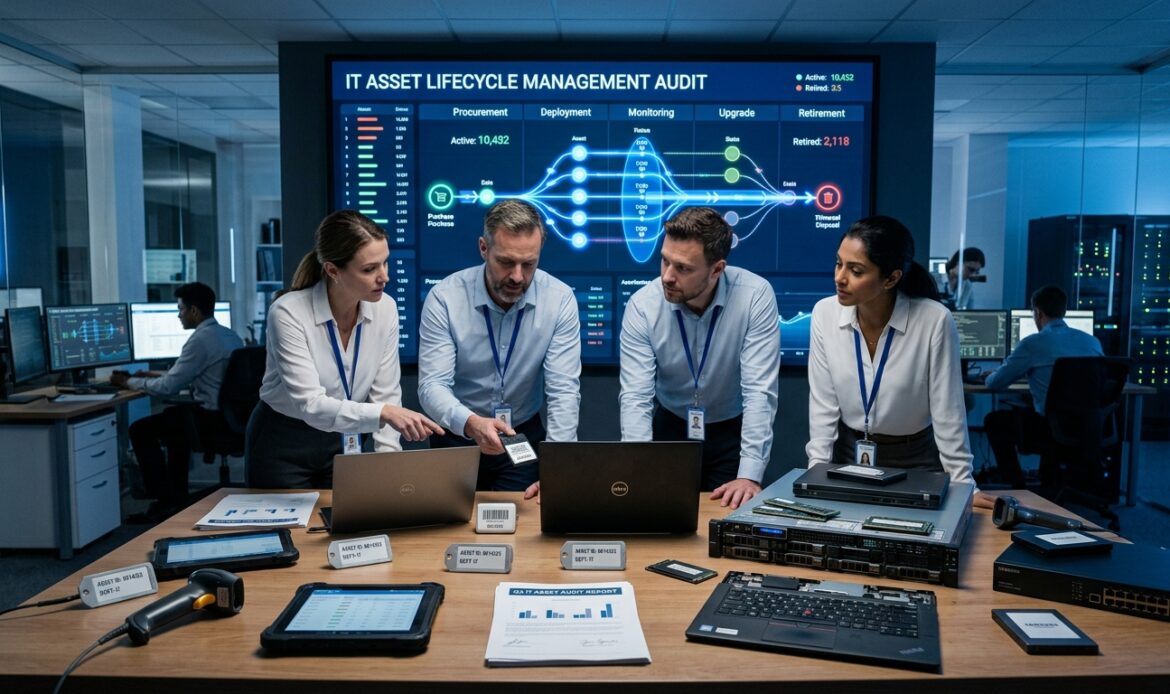
Asset lifecycle management is considered a core component of every IT asset management audit because it ensures that every technology resource is tracked from its initial purchase to its final disposal. In modern organizations, hardware, software, and cloud assets do not remain static; instead, they continuously move through different stages of usage, performance, and relevance. Without proper lifecycle control, assets can become outdated, misused, or completely untracked over time.
When an IT asset management audit is performed, the lifecycle of each asset is carefully reviewed to ensure proper utilization, compliance, and efficiency. This helps organizations understand whether their technology investments are being used effectively or simply generating unnecessary costs.
Procurement and Deployment
In this first stage of the IT asset management audit process, hardware and software assets are purchased, registered, and deployed according to organizational requirements. Proper documentation is maintained so that each asset is assigned to the correct department or user. This stage ensures that no asset enters the system without being officially recorded.
Monitoring and Maintenance
During this phase of the IT asset management audit, assets are continuously monitored to evaluate their performance, usage patterns, and security status. Regular maintenance activities such as updates, patches, and performance optimization are carried out. As a result, system stability and operational efficiency are maintained across the organization.
Upgrade and Replacement
In this stage, assets that are no longer performing efficiently are identified through the IT asset management audit process. These systems are either upgraded with newer technology or replaced entirely. This ensures that business operations are not slowed down by outdated or underperforming equipment.
Retirement and Disposal
During the final stage of the IT asset management audit lifecycle, outdated or unused assets are safely removed from the system. Proper disposal procedures are followed to prevent data leaks, security breaches, or compliance violations. This step is critical for maintaining data protection and regulatory compliance.
Through proper lifecycle optimization within an IT asset management audit, businesses are able to maximize the value of their technology investments while minimizing risks, waste, and inefficiencies.
How Software Compliance Is Checked During an IT Asset Management Audit
Software compliance management is one of the most important parts of an IT asset management audit. Many companies unknowingly violate software licensing agreements Software compliance management is one of the most critical components of an IT asset management audit because it ensures that all software used within an organization is properly licensed, updated, and legally authorized. In many cases, companies unintentionally violate licensing agreements simply because software records are incomplete, outdated, or poorly maintained. As a result, financial penalties and security risks can quietly build up over time.
During an IT asset management audit, software compliance is reviewed in detail to ensure that every installed application and subscription is properly accounted for and aligned with vendor requirements. This process helps organizations maintain transparency and avoid unnecessary legal or operational issues.
Several key areas are carefully reviewed during this stage:
- Licensed software inventory is checked to confirm that all installed tools are properly purchased and registered
- Expired subscriptions are identified to ensure that outdated licenses are renewed or removed
- Unauthorized applications are detected to prevent shadow IT and security risks
- SaaS asset management systems are evaluated for proper usage and subscription control
- Vendor compliance requirements are reviewed to ensure all legal obligations are being met
Through this structured approach, businesses are able to maintain accurate software records, reduce unnecessary spending, and strengthen compliance tracking. Consequently, organizations can avoid expensive legal penalties while also improving their overall IT asset management audit readiness and long-term governance stability.
How Cloud Systems Are Reviewed in an IT Asset Management Audit
Cloud technologies have significantly transformed the way modern businesses operate, but at the same time, they have introduced new levels of complexity and risk. In an IT asset management audit, cloud environments are carefully reviewed to ensure that all virtual resources are properly controlled, tracked, and aligned with organizational compliance requirements. Since cloud assets are not physically visible, they are often overlooked, which makes auditing even more essential.
During an IT asset management audit, cloud resources are analyzed to ensure proper usage, cost efficiency, and security governance. This process helps organizations maintain full visibility over their distributed digital infrastructure and prevents uncontrolled expansion of cloud services.
Cloud asset management within an IT asset management audit typically focuses on the following key areas:
- Cloud storage monitoring is performed to track data usage, storage costs, and unused space
- Virtual machine tracking is conducted to ensure active and inactive instances are properly managed
- SaaS subscription management is reviewed to avoid redundant or unnecessary subscriptions
- Remote server visibility is ensured so that all cloud-based servers remain fully documented and secure
- Backup system evaluation is carried out to confirm that data recovery systems are functioning correctly
Therefore, by including cloud environments in an IT asset management audit, organizations are able to reduce cloud-related risks, eliminate unnecessary expenses, and improve overall infrastructure efficiency and security.
Common Problems Found During an IT Asset Management Audit
An IT asset management audit often uncovers hidden issues that organizations were previously unaware of, especially when IT environments have grown rapidly without proper tracking or control. Since assets are continuously added, upgraded, and replaced, gaps in documentation and monitoring tend to develop over time. As a result, inefficiencies and security risks are frequently discovered during the audit process.
When an IT asset management audit is conducted properly, it highlights operational weaknesses that may be affecting cost, performance, and cybersecurity without being immediately visible to management.
Unused Software Licenses
One of the most common findings in an IT asset management audit is the presence of unused software licenses. In many cases, organizations continue paying for subscriptions that are no longer required or actively used. This leads to unnecessary financial waste and poor software asset management practices.
Outdated Hardware
Another major issue identified during an IT asset management audit is outdated hardware. Old devices often lack security updates and performance capabilities, making them potential entry points for cyberattacks. These systems can also slow down operations and reduce overall efficiency.
Poor Asset Documentation
In many audits, missing or incomplete records are discovered. Poor asset documentation creates confusion during compliance tracking and makes it difficult to verify asset ownership or usage history. This often results in inaccurate reporting and weak inventory management.
Shadow IT Issues
Shadow IT is another critical problem revealed during an IT asset management audit. Employees may install or use unauthorized applications without approval from the IT department. These tools are not monitored or secured properly, which increases the risk of data breaches and compliance violations.
As a result, IT asset management audits provide valuable insights that help organizations improve technology governance, strengthen security controls, and maintain better financial and operational efficiency.
Best Practices for Conducting an IT Asset Management Audit
Successful IT asset management audits require careful planning, strong consistency, and the effective use of automation tools. As technology environments continue becoming more complex, businesses must follow structured strategies to maintain accurate inventory management and compliance tracking. Without proper planning, important assets may be overlooked, which can lead to operational inefficiencies and security vulnerabilities.
Organizations that implement strong audit practices usually achieve better visibility, improved cybersecurity, and stronger technology governance. In addition, regular auditing helps businesses maintain better control over software licenses, cloud systems, and endpoint devices.
Several important best practices should always be followed during an IT asset management audit:
- Use automated asset discovery tools to identify connected devices, software applications, and cloud resources more accurately and efficiently
- Maintain updated inventory records so that asset ownership, configurations, and usage details remain properly documented
- Conduct audits regularly to ensure outdated systems, unused assets, and compliance risks are detected before they become serious problems
- Train employees on compliance policies so unauthorized software installations and shadow IT issues can be minimized
- Monitor software license usage carefully to prevent licensing violations, unnecessary subscriptions, and financial waste
By following these best practices, organizations can improve inventory accuracy, strengthen compliance management, and reduce operational risks. Consequently, IT asset management audit processes become smoother, faster, and far more reliable over the long term.
Discover more about asset deployment and the key 9 mistakes that can be avoided quickly for better IT management.
How Automation Enhances an IT Asset Management Audit
Automation is dramatically transforming the way an IT asset management audit is performed in modern organizations. Traditional methods that relied heavily on manual spreadsheets and physical recordkeeping are gradually being replaced by intelligent asset tracking systems, configuration management database tools, and automated monitoring platforms. As IT environments continue growing in size and complexity, automation has become essential for maintaining accuracy, speed, and operational efficiency.
During an IT asset management audit, automated systems are used to collect, update, and analyze asset information in real time. This reduces the workload placed on IT teams while also minimizing the risks associated with manual data entry and outdated records. In addition, automation provides better infrastructure visibility across hardware, software, cloud systems, and endpoint devices.
Automation enhances IT asset management audits in several important ways:
- Improving inventory accuracy by automatically detecting and updating asset information across the network
- Reducing human errors that commonly occur during manual documentation and spreadsheet management
- Providing real-time asset monitoring so businesses can track devices, software, and cloud resources continuously
- Simplifying compliance tracking through automated alerts and reporting systems that identify licensing or policy violations
- Enhancing audit documentation by generating organized records, reports, and asset histories automatically
As a result, businesses are able to conduct IT asset management audits faster, more efficiently, and with greater accuracy. Consequently, organizations can strengthen compliance management, improve cybersecurity monitoring, and maintain better control over their entire technology ecosystem.
Financial Benefits of an IT Asset Management Audit
An IT asset management audit can provide significant financial advantages for businesses by helping them identify waste, improve resource allocation, and reduce unnecessary technology expenses. In many organizations, IT costs gradually increase because hardware, software, and cloud resources are not monitored properly. As a result, companies often continue paying for assets that are outdated, unused, or duplicated across departments.
Through a structured IT asset management audit, businesses gain better visibility into their technology ecosystem and can make smarter financial decisions. The audit process helps organizations understand where money is being wasted and where improvements can be made to increase operational efficiency.
Several important financial benefits can be achieved through an IT asset management audit:
- Eliminating duplicate software purchases by identifying applications that have already been licensed or installed within the organization
- Removing unused cloud subscriptions that continue generating monthly costs without providing business value
- Reducing emergency repair costs through proactive monitoring and maintenance of hardware assets
- Improving resource allocation by ensuring technology assets are distributed and utilized efficiently across departments
- Preventing compliance penalties by maintaining proper software license management and audit readiness
In addition, businesses can improve budgeting and long-term financial planning because accurate inventory data becomes available through the audit process. Consequently, organizations are able to increase profitability, strengthen operational efficiency, and gain better control over their overall IT spending.
How Small Businesses Benefit from an IT Asset Management Audit

Small businesses often believe audits are only necessary for large corporations. However, an IT asset management audit can provide major advantages for smaller Small businesses often assume that an IT asset management audit is only necessary for large corporations with massive IT infrastructures. However, this belief can lead to overlooked risks and unnecessary operational costs. In reality, small businesses rely heavily on technology for daily operations, communication, customer management, and data storage. Therefore, even smaller organizations can experience serious issues when IT assets are not monitored properly.
An IT asset management audit helps small businesses gain complete visibility over their technology resources, including hardware devices, software applications, cloud services, and network systems. Since smaller companies usually operate with limited budgets and IT staff, proper asset management becomes even more important for maintaining efficiency and reducing waste.
Small businesses can benefit from an IT asset management audit in several important ways:
- Better technology organization by maintaining accurate records of devices, software, and digital resources
- Improved cybersecurity protection through the identification of outdated systems and unauthorized applications
- Reduced IT spending by eliminating unnecessary subscriptions, duplicate software purchases, and unused assets
- Stronger compliance management by ensuring software licenses and data protection requirements are properly maintained
- Better infrastructure visibility so business owners can monitor their entire IT environment more effectively
In addition, regular audits help small businesses prepare for future growth because technology resources are managed more strategically. Even a simple IT asset management audit can help smaller companies avoid major long-term problems, reduce operational risks, and build a more secure and efficient digital environment.
Future Trends Shaping the IT Asset Management Audit Industry
The future of the IT asset management audit industry is being rapidly transformed by advanced technologies such as artificial intelligence, predictive analytics, machine learning, and cloud automation. As modern IT environments continue becoming more complex, businesses are demanding smarter and faster ways to manage their technology assets. Consequently, traditional auditing methods are gradually being replaced by intelligent systems capable of monitoring and analyzing assets in real time.
Organizations are now focusing on automation-driven solutions that improve inventory accuracy, strengthen cybersecurity, and simplify compliance management. In addition, remote work environments and cloud-based infrastructures are increasing the need for more advanced asset visibility and monitoring systems.
Several emerging trends are becoming increasingly popular within the IT asset management audit industry:
- AI-powered asset tracking is being used to automatically identify, monitor, and manage hardware and software assets across networks
- Predictive maintenance systems are helping organizations detect performance issues before equipment failures occur
- Automated compliance management is simplifying software license tracking and reducing the risk of regulatory violations
- Smarter endpoint asset management is improving the monitoring and protection of remote devices and connected systems
- Integrated cybersecurity monitoring is combining asset management with threat detection to strengthen overall digital security
Furthermore, cloud-based asset management platforms are making it easier for businesses to manage distributed IT infrastructures from centralized systems. Real-time analytics and automated reporting tools are also improving decision-making and operational efficiency.
Why IT Governance Depends on an IT Asset Management Audit
Strong IT governance cannot be effectively established or maintained without a proper IT asset management audit. In modern organizations, governance frameworks rely heavily on accurate asset visibility, structured documentation, and continuous compliance tracking. Without a clear understanding of what technology assets exist within the organization, it becomes extremely difficult to enforce policies, manage risks, or ensure accountability across departments.
An IT asset management audit plays a central role in aligning technology resources with governance objectives. It provides a structured overview of all hardware, software, cloud systems, and endpoint devices, ensuring that every asset is properly recorded, monitored, and evaluated. As a result, organizations are able to make more informed decisions and maintain stronger control over their IT environments.
IT asset management audits support IT governance in several important ways:
- Improving asset accountability by clearly identifying ownership and usage of all IT resources
- Strengthening operational controls through better monitoring of systems and standardized processes
- Supporting technology risk assessment by identifying outdated, vulnerable, or unauthorized assets
- Enhancing audit documentation to ensure accurate records for internal and external compliance requirements
- Improving policy enforcement by ensuring that IT rules and standards are properly applied across the organization
In addition, governance frameworks become more effective when supported by consistent audit practices, as they allow businesses to detect issues early and maintain regulatory compliance more easily.
Conclusion
An IT asset management audit is far more than a simple inventory review. It is a powerful business strategy through which organizations can improve cybersecurity, strengthen compliance management, and reduce operational waste. Without proper audits, technology environments can become disorganized, expensive, and vulnerable to cyber threats.
Fortunately, with strong asset lifecycle management, automated asset discovery tools, and regular compliance reviews, businesses can maintain complete control over their digital ecosystems.
In the end, an IT asset management audit acts like a digital compass inside a complex technology landscape. Hidden risks are uncovered, valuable resources are optimized, and smarter business decisions are made possible. Therefore, companies that invest in regular audits are often better prepared for long-term growth, stability, and digital success.
FAQs About It Asset Management Audit
What is an IT asset management audit?
An IT asset management audit is a process in which all hardware, software, cloud systems, and digital resources within a company are reviewed and tracked carefully. The audit is conducted to improve inventory accuracy, compliance tracking, and operational efficiency. During the process, asset ownership, software licenses, and security risks are analyzed. As a result, businesses are provided with better visibility and control over their IT infrastructure.
Why is an IT asset management audit important for cybersecurity?
An IT asset management audit is considered important because unknown or outdated devices can create serious security vulnerabilities inside company networks. Through regular audits, unauthorized software, unsupported systems, and weak endpoint devices can be identified quickly. Cybersecurity risks are reduced because better infrastructure visibility and asset monitoring are achieved. Consequently, businesses are protected more effectively from cyberattacks and data breaches.
How often should an IT asset management audit be performed?
An IT asset management audit should be performed regularly to maintain accurate inventory management and compliance readiness. Many organizations conduct audits quarterly or annually depending on the size of their IT environment. However, businesses with large cloud systems or remote workforces may require more frequent reviews. Regular audits help companies detect hidden problems before they become expensive or dangerous.
What are the main benefits of an IT asset management audit?
Several benefits can be achieved through an IT asset management audit, including improved cybersecurity, reduced operational costs, and stronger software compliance management. The audit also helps businesses remove unused software licenses, monitor cloud resources, and improve resource allocation. Better asset lifecycle management can be maintained because technology assets are tracked more accurately. Therefore, organizations are allowed to operate more efficiently and securely.