


Asset Deployment is widely recognized as the backbone of modern IT operations. Whether its business or a personal project using your assets at the right place is the key to sucess. Without an effective deployment strategy, devices can be untracked, softwares may be misconfigured and performance can be slowed down like traffic traped in a tech thunderstrom. From hardware deployment to software deployment every company or business depends strongly on efficient system supply and deployment management.
Moreover, businessess are being push towards using smarter IT asset management because technology is evolving at extraordinary speed. Whether the laptops are used in companies by employess or used by individuals at home, the asset lifecycle management must be handled carefully. Automated deployment tools, cloud based monitoring systems, and resources management solutions are now implemented to improve workflow optimization and reduce human error. Regardless the digital assets are distributed to remote employees, servers are being installed on multiple office locations or mobile devices are arranged for field workers, the whole process of deployment need proper and strategic management planning.
In addition effective asset utilization directly contributes to digital security, compliance and enviromental objectives. An effective deployment ensures that system receives security patches, encryption settings and gets the control before employee begin using them. At the same time organizations can check the performace of assets, they can extend equipment lifespan, and control electronic waste through right asset disposal processes. In today’s networked enterprise ecosystem successful asset deployment is not just a task. It has become the organization pillar that supports productivity, security, flexibility and long term technological evolution.
Table of Contents
Overview of Understanding Asset Deployment
In the modern tech world, asset deployment is the process of distributing, preparing and managing technological resources so the performaces of business becomes smoth and efficient. — Asset deployment refers to the process of planning, configuring, distributing, and managing organizational assets so they can be used efficiently within business operations. These assets may include computers, servers, mobile devices, networking equipment, software applications, cloud systems, or other technological resources that support daily workflows. In modern organizations, asset deployment acts like the invisible circuitry behind productivity, quietly powering communication, collaboration, and operational stability.
Understanding asset deployment is important because businesses today depend heavily on technology-driven environments. Every device or software system must be properly installed, configured, tested, and assigned before employees can use it effectively. A poorly managed deployment process can lead to delays, compatibility issues, security vulnerabilities, and unnecessary operational costs. On the other hand, a well-structured deployment strategy helps organizations improve efficiency, maintain security standards, and reduce downtime.
The asset deployment process usually begins with procurement and planning. Businesses first identify their technological needs and then acquire the required hardware or software resources. After procurement, assets are configured according to company requirements. This may involve installing operating systems, setting up security protocols, applying software updates, and assigning user permissions. Once prepared, the assets are distributed to employees, departments, or office locations where they become part of the organization’s active IT infrastructure.
About Asset Deployment Transactions
Asset deployment transactions are referred to as the activities involved in assigning, transferring, configuring, tracking, and managing IT assets during the deployment process. These transactions are usually recorded within IT asset management systems so that every movement of an asset can be monitored accurately.
For example, when a laptop is issued to an employee, a deployment transaction is created automatically. Similarly, when software deployment is completed, the installation details are documented for future tracking and maintenance purposes.
Moreover, asset deployment transactions help businesses maintain transparency across the entire deployment lifecycle. Without proper transaction records, devices may be lost, duplicated, or mismanaged like puzzle pieces scattered across a crowded table.
Several important actions are included in deployment transactions:
- Asset provisioning and allocation
- Device configuration management
- Hardware deployment tracking
- Software installation records
- Asset transfer and reassignment
Additionally, deployment transactions are considered essential for compliance, security audits, and asset inventory management. Businesses can easily verify who received a device, when it was deployed, and how it is currently being used.
Because of increasing remote deployment practices, transaction monitoring has become even more important. Devices are now being shipped, activated, and managed across multiple locations worldwide. Therefore, accurate deployment management systems must be implemented to ensure operational efficiency and accountability.
In many organizations, asset deployment transactions act like a digital breadcrumb trail. Every step taken by an IT asset is recorded carefully, allowing businesses to improve asset tracking, reduce errors, and strengthen technology asset management over time.
Why Asset Deployment Matters in Modern Businesses
In today’s technology-driven environment, asset deployment has become an essential component of business operations. Modern organizations rely heavily on computers, servers, cloud systems, mobile devices, and networking equipment to maintain productivity and communication. Without a structured deployment strategy, businesses can quickly fall into operational disorder. Delays may occur during device distribution, assets could become misplaced, and employees might be left waiting for properly configured systems before they can begin their work efficiently. Even small deployment errors can create a domino effect that disrupts entire workflows across multiple departments.
Moreover, the rapid growth of hybrid and remote workplaces has significantly increased the demand for efficient remote deployment solutions. Employees are no longer confined to a single office location. Devices now need to be configured, secured, and deployed across multiple cities, remote workspaces, and branch offices. Because of this shift, businesses are increasingly investing in automated deployment systems and cloud-based deployment management tools that allow IT teams to control devices remotely while reducing manual workload.
Asset deployment also plays a critical role in maintaining cybersecurity and operational stability. Improperly deployed devices may contain outdated software, missing security patches, or incorrect access permissions that expose organizations to cyber threats. Structured deployment procedures help ensure that every system is configured according to company policies before employees begin using it. This proactive approach strengthens security while minimizing downtime and technical complications.
Key Benefits of Asset Deployment
1. Productivity Is Improved Across Departments
Efficient asset deployment ensures that employees receive properly configured devices without unnecessary delays. This allows teams to begin working immediately, reducing downtime and improving overall productivity across departments.
2. Device Lifecycle Management Becomes Easier
A structured deployment process helps organizations monitor devices throughout their entire lifecycle, including procurement, maintenance, upgrades, redeployment, and disposal. This improves long-term asset management and budgeting accuracy.
3. Security Risks Are Reduced Significantly
Proper deployment procedures ensure that systems are updated with the latest security patches, encryption settings, and compliance policies before use. This reduces vulnerabilities and protects sensitive organizational data.
4. Asset Tracking Is Streamlined Effectively
Modern deployment management systems allow businesses to track devices, software licenses, and hardware usage in real time. Accurate tracking helps prevent asset loss while improving accountability.
5. IT Infrastructure Setup Is Simplified
Deployment frameworks standardize configuration and installation procedures, making it easier to scale IT infrastructure across offices, departments, and remote teams.
As a result, organizations are increasingly being encouraged to invest in automated deployment systems, remote configuration tools, and intelligent asset management solutions that support scalability, efficiency, and digital transformation.
How the IT Asset Deployment Process Works
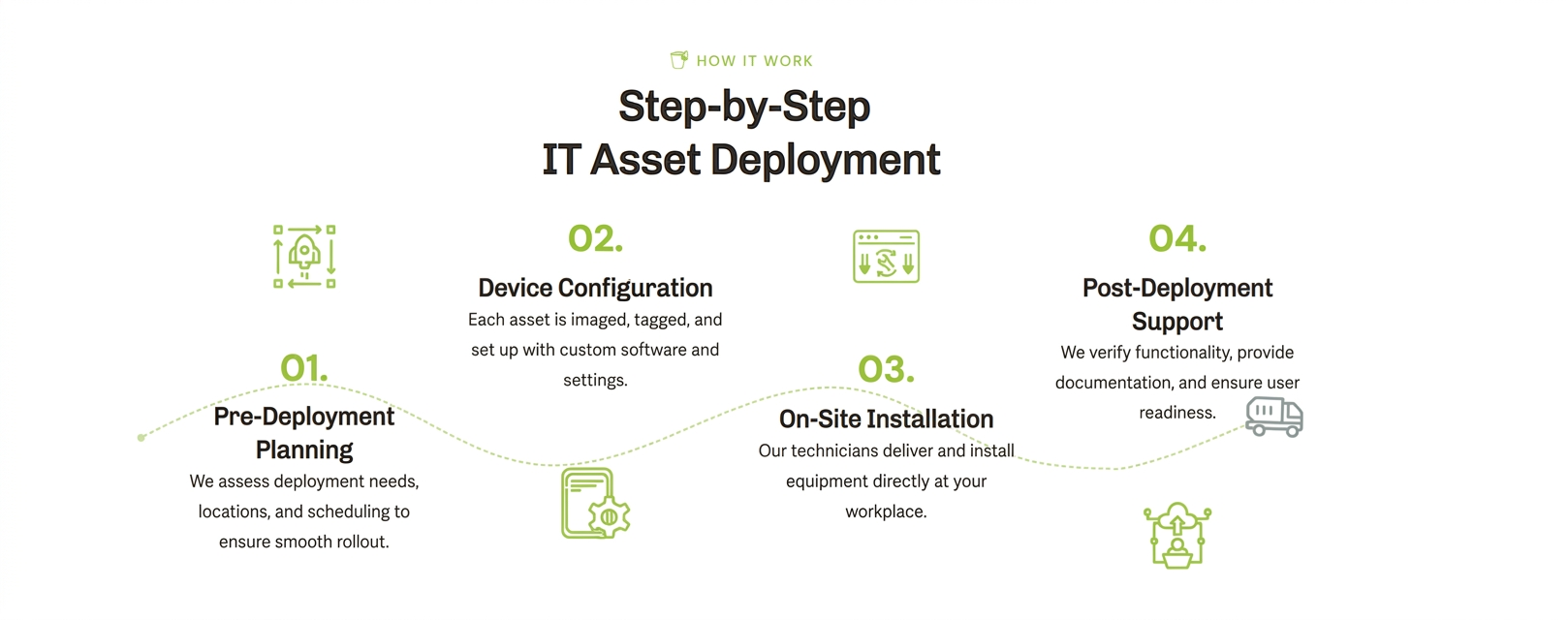
The IT asset deployment process follows a structured sequence of stages designed to ensure smooth implementation, optimal resource utilization, and long-term system reliability. Each phase contributes to reducing technical risks, improving operational efficiency, and building a secure and scalable IT environment. From initial planning to ongoing maintenance, every step plays a vital role in the overall deployment lifecycle.
1. Planning and Assessment
The process starts with detailed planning and assessment. At this stage, organizational requirements are analyzed to determine the required hardware, software, and IT infrastructure. IT teams evaluate user needs, deployment locations, network capacity, security requirements, and project timelines.
This stage is critical because weak planning can lead to system failures, budget overruns, and compatibility issues. A well-defined assessment helps create a clear deployment strategy that minimizes risks and ensures smooth execution.
2. Asset Procurement
After planning is completed, the necessary IT assets are procured. These may include laptops, desktops, servers, networking equipment, mobile devices, software licenses, and cloud-based solutions. Procurement decisions are guided by business goals, scalability needs, and budget constraints.
During this phase, vendors are evaluated for reliability, support quality, pricing, and warranty terms. Ensuring compatibility and quality at this stage helps prevent operational disruptions later in the deployment process.
3. Configuration and Provisioning
Once assets are acquired, they are prepared for organizational use through configuration and provisioning. This involves installing operating systems, essential software applications, security patches, and company-specific configurations.
Devices are also assigned user roles, network permissions, and cybersecurity settings. Many organizations use automated provisioning tools to ensure consistency, speed up setup, and reduce human error across systems.
Proper configuration is essential, as incorrect setup can lead to security vulnerabilities, system inefficiencies, and productivity issues.
4. Deployment and Installation
In this stage, configured IT assets are deployed across the organization. This includes distributing devices, setting up workstations, installing servers, integrating networks, and enabling cloud connectivity.
IT teams conduct system checks and performance testing to ensure all assets function correctly before full-scale usage begins. In remote or hybrid work environments, deployment tools enable centralized configuration and management without requiring physical setup at each location.
5. Monitoring and Maintenance
After deployment, continuous monitoring and maintenance ensure long-term efficiency and system stability. IT teams track performance metrics, security updates, hardware health, and software compliance.
Regular maintenance helps identify issues early, reduce downtime, and extend asset lifespan. This phase may also include troubleshooting, upgrades, asset optimization, and end-of-life planning such as recycling or secure disposal.
9 Powerful Mistakes Avoided Fast
Whether it is a business or a personal project, using your resources (assets) in the right place is the key to success. However, people often make certain mistakes during “Asset Deployment” that waste both their time and money. By avoiding these 9 mistakes, you can achieve the best possible results from your assets:
1. Poor Risk Assessment
- Many organizations still depend on fixed age-based replacement schedules instead of analyzing the real condition of their technology assets. As a result, devices that are functioning properly may be replaced too early, while failing equipment could remain in operation until a major breakdown occurs.
- Critical warning signs such as overheating, declining performance, or unusual maintenance frequency are often ignored during deployment planning and asset lifecycle management.
- Emergency repairs are usually far more expensive than preventive maintenance. In many cases, sudden system failures can interrupt business operations, delay deployment services, and reduce employee productivity significantly.
- Furthermore, poor risk assessment may increase security vulnerabilities because outdated or unstable systems are more likely to fail under pressure.
- To reduce these risks, predictive analytics, IoT sensors, and component-level monitoring should be integrated into deployment management systems. Consequently, businesses can identify problems before they become costly disasters.
2. Disconnected Data
- Asset information is frequently scattered across spreadsheets, emails, and disconnected software systems. Therefore, IT teams may struggle to maintain accurate asset inventory management records.
- When deployment transactions are not centralized, duplicate purchases, missing devices, and incorrect asset tracking can occur easily.
- Additionally, disconnected data creates confusion during hardware deployment and software deployment processes because teams may rely on outdated information.
- Budget planning can also be negatively affected since incomplete records make forecasting difficult. As a result, replacement cycles may be delayed or overspending could occur unexpectedly.
- To solve this issue, organizations should centralize their records using integrated IT asset management or ERP systems. This approach allows real-time monitoring, better reporting, and smoother deployment lifecycle management.
3. Ignoring Lifecycle Costs
- Many businesses focus only on the upfront purchase price of an asset while ignoring long-term operational costs such as maintenance, upgrades, software licensing, and energy consumption.
- Although a cheaper device may appear attractive initially, hidden lifecycle costs can slowly drain company resources like a leaking faucet filling a basement over time.
- Operational expenses often account for the majority of total ownership costs. Therefore, overlooking them may lead to inaccurate budgeting and poor deployment strategy decisions.
- Furthermore, assets with low initial costs may require frequent repairs, which can disrupt deployment management and reduce efficiency.
- To avoid these problems, businesses should adopt Total Cost of Ownership (TCO) models when planning enterprise asset deployment. Consequently, smarter long-term investment decisions can be made.
4. Neglecting Maintenance
- Scheduled maintenance is often delayed or skipped entirely because organizations become too focused on daily operations. However, neglected maintenance can silently shorten the lifespan of valuable technology assets.
- Dust buildup, outdated software patches, overheating, and worn-out components may gradually damage systems if regular maintenance is ignored.
- Unexpected failures can lead to downtime, productivity loss, and emergency deployment costs that are far higher than preventive care expenses.
- In addition, neglected maintenance may create compliance and security risks because unsupported systems are more vulnerable to cyber threats.
- Preventive and predictive maintenance schedules should be implemented consistently. As a result, businesses can improve asset reliability, reduce failures, and extend deployment lifecycle performance.
5. Weak Record-Keeping
- Incomplete or inaccurate documentation can create serious operational challenges during asset deployment and IT asset management processes.
- Missing deployment records may cause confusion regarding ownership, maintenance schedules, warranty status, or device location. Consequently, compliance audits can become stressful and time-consuming.
- Financial reporting may also be affected because poorly documented assets can lead to inaccurate depreciation calculations and budgeting errors.
- Additionally, manual record-keeping systems increase the chances of human error, duplicated entries, and missing deployment transactions.
- Automated record-keeping systems with audit trails should be implemented to improve transparency and accountability. Therefore, businesses can maintain accurate deployment tracking and regulatory compliance more effectively.
6. Ignoring Asset History
- Without historical data, organizations are essentially making deployment decisions while blindfolded. Important details regarding repairs, usage patterns, and maintenance history may be lost completely.
- Assets that frequently fail may continue being redeployed unnecessarily because historical performance records are unavailable.
- Moreover, businesses may replace functional assets too early simply because previous maintenance data was not tracked properly.
- Ignoring asset history can also increase operational costs because poor replacement decisions waste valuable capital and deployment resources.
- To improve decision-making, maintenance records, ownership history, deployment transactions, and usage data should be stored within a centralized database. Consequently, organizations can optimize deployment lifecycle management more accurately.
7. Failure to Diversify
- Relying heavily on a single vendor, technology provider, or hardware model can expose businesses to serious operational risks.
- If supply chain disruptions occur, organizations may struggle to continue deployment services or replace damaged assets quickly.
- Additionally, depending on one technology ecosystem may limit flexibility, scalability, and innovation opportunities.
- Vendor-specific failures, security issues, or pricing increases can create massive deployment management challenges if diversification strategies are ignored.
- Businesses should spread investments across multiple vendors, technologies, and geographic regions whenever possible. As a result, deployment risks can be minimized while operational resilience is strengthened.
8. Ignoring Technological Advancements
- Technology evolves rapidly, yet many organizations continue using outdated deployment systems that slow down operations and reduce productivity.
- Older systems may lack compatibility with modern software deployment tools, cloud deployment environments, and endpoint management solutions.
- Furthermore, outdated technology often increases operational costs because maintenance requirements become more frequent over time.
- Businesses that ignore technological advancements may also struggle to compete in fast-moving markets where automation and digital transformation are becoming essential.
- Modern solutions such as AI-powered deployment systems, IoT monitoring sensors, and automated asset provisioning tools should be adopted strategically. Consequently, businesses can improve scalability, efficiency, and long-term growth potential.
9. Skipping Audits and Reviews
- Regular audits are often overlooked because they are considered time-consuming or unnecessary. However, hidden inefficiencies and deployment errors can remain undetected without proper reviews.
- Missing devices, inaccurate asset inventory management records, and unauthorized usage may continue for years if audits are ignored.
- Compliance failures can also occur because outdated systems and missing documentation may violate industry regulations.
- Furthermore, fraud risks increase when deployment transactions and asset tracking activities are not reviewed consistently.
- Periodic audits and performance evaluations should be conducted to ensure accurate deployment management and operational transparency. Therefore, businesses can identify inefficiencies early and maintain stronger control over their IT assets.
Why Automated Deployment Is Changing the Game
Automation is transforming deployment services dramatically. Tasks that once required hours can now be completed within minutes. Imagine manually configuring 500 laptops one by one. Sounds exhausting, right? Fortunately, automated deployment tools can perform those tasks almost like a digital assembly line.
Advantages of Automated Deployment
- Human errors are minimized
- Deployment speed is increased
- Remote deployment becomes easier
- Configuration management improves
- Scalability is enhanced
As businesses continue growing, automated deployment will likely become the industry standard. Automation reduces deployment errors by up to 70%+ and improves consistency ResearchGate – Infrastructure as Code (IaC) Study
Security Considerations in Asset Deployment
Security must never be ignored during technology deployment. A poorly secured deployment process can expose sensitive business data.
For this reason, security protocols should be integrated into every stage of system deployment.
Important Security Measures
- Endpoint protection software should be installed
- Access controls must be enforced
- Encryption should be enabled
- Security patches need to be updated regularly
- Device authentication protocols must be applied
Consequently, secure device deployment processes can help businesses avoid costly cyber threats.
Remote Workforce and Asset Deployment
Remote work has reshaped deployment management entirely. Employees now expect devices to arrive fully configured, secured, and ready to use immediately. Therefore, businesses are being forced to modernize their asset deployment strategies to support distributed teams effectively.
Growing Demand for Remote Device Deployment
Because of the rise of hybrid and remote workplaces, remote workforce device deployment has become increasingly important. Businesses now need to handle laptop deployment, mobile device management, and software deployment for employees working across different locations.
Additionally, faster deployment services are expected because remote employees cannot afford long setup delays that interrupt productivity.
Role of Cloud Deployment and Automation
Cloud deployment and automated deployment systems are being adopted widely across industries. Through remote configuration management, devices can be prepared, updated, and secured without requiring employees to visit physical offices.
Moreover, enterprise mobility solutions allow businesses to manage endpoint deployment remotely while maintaining consistent system configurations across all devices.
Benefits of Remote Asset Deployment
Remote deployment strategies provide several operational advantages for businesses:
- Faster employee onboarding
- Reduced operational costs
- Improved deployment efficiency
- Easier global workforce support
- Better scalability for growing teams
As a result, organizations are able to support remote employees more smoothly and efficiently.
How Asset Deployment Supports Digital Transformation

Digital transformation depends heavily on successful enterprise asset deployment because modern technologies cannot function efficiently without a strong IT foundation. As businesses continue adopting cloud computing, automation, remote work systems, and advanced digital platforms, deployment management has become a critical part of organizational growth and innovation.
Reliable Infrastructure Supports Modern Technology
Modern digital systems require reliable infrastructure deployment to operate effectively. Cloud platforms, enterprise applications, and remote collaboration tools all depend on properly configured devices, stable networks, and secure system integration.
Without structured deployment processes, businesses may experience connectivity issues, system downtime, and reduced operational performance.
Cloud and Remote Work Environments Require Efficient Deployment
The rise of hybrid and remote workplaces has increased the importance of deployment planning significantly. Employees now rely on laptops, mobile devices, cloud software, and virtual communication platforms to perform daily tasks from different locations.
To support these environments, businesses must ensure that devices are configured correctly, software applications are installed properly, and cybersecurity settings are applied before deployment.
Deployment Strategies Improve Business Agility
Organizations that invest in deployment strategy improvements are often able to adapt faster to changing market conditions and evolving customer expectations. Automated deployment systems, remote provisioning tools, and centralized asset management platforms help businesses scale operations more efficiently while reducing manual errors and technical delays. This flexibility allows companies to implement new technologies faster and maintain a competitive advantage.
Asset Deployment Strengthens Cybersecurity
Digital transformation also increases cybersecurity challenges because more devices, cloud systems, and user accounts become connected to organizational networks. Structured asset deployment helps businesses apply security patches, encryption protocols, access controls, and compliance policies before systems are used by employees. As a result, organizations can reduce vulnerabilities and improve overall data protection.
Connected Systems Create Smoother Operations
In many ways, asset deployment acts like the nervous system of digital transformation. When devices, applications, networks, and digital resources are connected properly, information flows smoothly throughout the organization. This improves collaboration, streamlines workflows, increases productivity, and helps businesses operate more efficiently in an increasingly technology-driven environment.
Explore how sustainable practices create environmental and financial value in our guide to the advantages of e-waste recycling.
Future Trends in Asset Deployment
Technology never stands still. As a result, deployment management continues evolving rapidly toward more automation, intelligence, and sustainability.
AI-Powered Deployment
Artificial intelligence is being integrated into automated deployment systems to make decisions faster and more accurately.
- Predicts optimal device configurations based on user roles and usage patterns
- Detects and resolves deployment errors before they impact end users
- Automates software installation and system setup with minimal human input
Zero-Touch Deployment
Devices are being configured automatically without manual intervention, reducing setup time and technical workload.
- Enables instant device setup from anywhere through cloud-based provisioning
- Automatically applies company policies, security settings, and applications
- Reduces dependency on IT teams for large-scale onboarding processes
Cloud-Native Infrastructure
Cloud deployment solutions are becoming increasingly dominant as businesses move away from traditional on-premise systems.
- Allows scalable deployment of assets across global teams in real time
- Centralizes management of devices, software, and configurations in one platform
- Improves flexibility by enabling remote updates and system control
Advanced Endpoint Management
Smarter endpoint deployment and monitoring tools are being developed to enhance security and control.
- Provides real-time visibility into all connected devices and assets
- Strengthens cybersecurity through automated threat detection and response
- Supports remote troubleshooting and performance optimization
Sustainable IT Practices
Eco-friendly asset provisioning and equipment recycling practices are being prioritized in modern IT strategies. Optimizes energy consumption in deployed devices and systems Encourages reuse, refurbishment, and responsible disposal of IT assets Reduces electronic waste through efficient lifecycle management.
Choosing the Right Asset Deployment Solution
Not every deployment system fits every organization. Some businesses may require extensive enterprise asset deployment solutions, while others may only need basic workstation setup services.
When selecting deployment services, businesses should evaluate:
- Scalability requirements
- Security features
- Integration capabilities
- Remote deployment support
- Cost efficiency
After all, choosing the wrong deployment solution is like using a bicycle tire on a jet plane. It simply will not work properly.
Conclusion
Asset deployment plays a critical role in modern business success. From hardware deployment and software installation to endpoint management and deployment lifecycle monitoring, every stage contributes to operational efficiency.
Furthermore, automated deployment, accurate asset tracking, and secure configuration management are being recognized as essential components of successful IT operations.
As digital transformation continues accelerating, businesses that master enterprise asset deployment will likely stay ahead of competitors. Meanwhile, organizations that ignore proper deployment planning may struggle with delays, inefficiencies, and security risks.
FAQs About Asset Deployment
What is asset deployment in simple words?
Asset deployment is the process of installing, configuring, and distributing IT assets like laptops, servers, software, and network devices so they are ready for use within an organization. It ensures systems are fully functional before being handed to employees.
Why is asset deployment important for businesses?
It is important because smooth asset deployment improves productivity, reduces downtime, and ensures employees get ready-to-use devices. Additionally, it supports better IT asset management, security, and operational efficiency across the organization.
What are the main stages of asset deployment?
Planning and requirement analysis, asset procurement and inventory management, configuration and asset provisioning, installation and system deployment, monitoring and maintenance.
How does remote workforce affect asset deployment?
Remote workforce environments have increased the need for remote deployment. Devices are now shipped directly to employees and configured using cloud deployment, remote configuration management, and automated deployment systems without physical IT support.